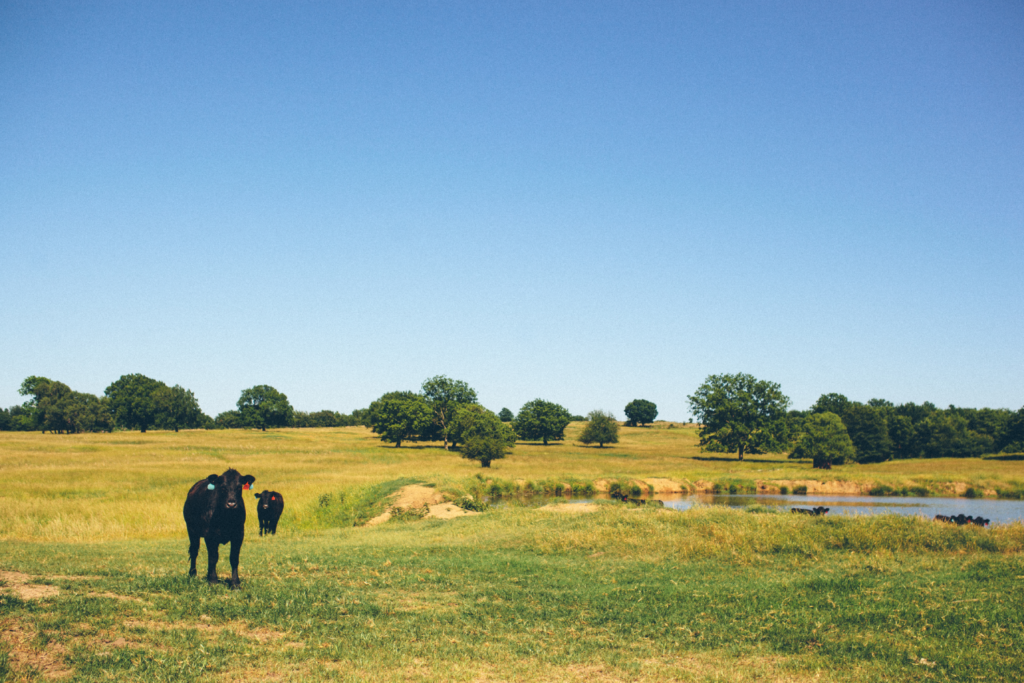
Around here we talk a whole lot about porches, but the “pastures” half of our name is every bit as close to our hearts. Lake Eufaula country is so much more than shoreline. It’s rolling pasture, wooded ridges, hay meadows, and quiet stretches of acreage where you can finally spread out, run a few head of cattle, hunt your own back forty, or build the place you’ve been picturing for years.
Buying land is a different animal than buying a house in town, though. There’s no home inspector walking you through a tidy list, and a lot of what matters most is invisible from the road. So before you fall head over heels for that “for sale” sign on a pretty piece of grass, here’s what our Pastures team actually looks at when we walk land with buyers.
And there’s a lot to love out here. Lake Eufaula is the largest lake located entirely in Oklahoma, with more than 800 miles of shoreline spread across four counties (McIntosh, Pittsburg, Haskell, and Okmulgee). It sits about 90 minutes from Tulsa and roughly two hours from Oklahoma City, and land in this part of the state is still more affordable than most lake markets in the country. That combo is exactly why so many folks are buying acreage here. If you want the full love letter, we wrote up 25 Reasons to Live at Lake Eufaula.
Start With What You Want the Land to Do
This is the question we ask first, because the answer changes everything else. Are you looking to graze cattle or cut hay? Keep horses? Hunt and fish your own ground? Build a forever home, a weekend cabin, or a lake place that pays for itself? Buy and hold a chunk of dirt as a long-term investment? Or a little of all of the above?
There are no wrong answers, but the “best” parcel for a cattle operation is not the same as the best parcel for a secluded hunting retreat or a buildable lakefront lot. Nail down your goal early and every other decision gets easier. We break down the classic land strategies (buy and hold, flip, develop, and lease) in our post on finding Oklahoma land for sale, and it’s a great companion to this one.
How to Evaluate a Piece of Land
Once you know your goal, it’s time to size up the property itself. Here’s the honest checklist we run through.
Walk it, more than once. Photos and aerial maps are a start, but nothing replaces boots on the ground. Try to see a property in different conditions if you can. A field that looks perfect in October can tell a very different story after a good spring rain, and low spots, drainage problems, and boggy ground show themselves fast once the water shows up.
Get a survey and don’t trust the fence. Here’s a mistake we see all the time: buyers assume the old fence line is the property line. In Oklahoma, that’s often not the case. Fences get built for convenience, not surveys, and courts have ruled plenty of times that a fence only becomes the legal boundary under specific, long-standing conditions. Before you build, plant, or improve anything, confirm the actual corners with a current survey so you’re not paying to undo your own work later.
Check access and easements. Can you legally and physically get to the property year round? Look for frontage on a county-maintained road, and find out whether the land is landlocked or reached by an easement across someone else’s property. Easements cut both ways, too. Someone else may have the right to cross your land for utilities, a shared driveway, or pipeline access, so ask what’s recorded against the parcel.
Look at topography, soil, and drainage. The lay of the land affects what you can build, where water pools, and whether the ground will support a septic system (more on that below). If you plan to farm or graze, soil quality is the whole ballgame. If reports on topography, soil, or drainage aren’t available, it’s worth ordering them so you have a clear picture before you sign.
Confirm the flood situation. Lake Eufaula is a flood control lake and water levels rise and fall, so check FEMA flood maps and understand how the site sits relative to the flood pool. A gorgeous low lot can turn into a soggy headache.
Read the zoning, restrictions, and covenants. A lot of land around the lake sits in unincorporated county areas where oversight is lighter, which is one of the perks of rural living. But some parcels sit inside developments or subdivisions with covenants, minimum square footage rules, or limits on things like mobile homes, livestock, or short-term rentals. Always read the restrictions before you buy, not after.
Find out about the mineral rights. This one is big in Oklahoma and it catches out-of-state buyers off guard.
A Word on Mineral Rights
In Oklahoma, the ground beneath your feet is its own legal estate. Mineral rights (oil, gas, coal, and other resources under the surface) are treated as real property and can be sold, leased, or inherited completely separately from the surface. You’ll hear three terms: a unified estate, where the same owner holds both the surface and the minerals; a split or severed estate, where the minerals belong to someone else; and a fractional estate, where the minerals are divided among several owners.
Here’s the part that surprises people: in Oklahoma the mineral estate is considered “dominant,” which means a mineral owner generally has the right to reasonable surface access to explore and develop what’s underneath. And in a lot of Oklahoma counties, the minerals were severed generations ago, so a seller can only pass along what they actually own. If a listing says “mineral rights included,” that’s worth verifying, not assuming. Your agent and a title company can trace the chain of title at the county clerk’s office, and the Oklahoma Corporation Commission keeps records of drilling activity. Know what you’re getting before you sign.
Water, Fencing, Wells, and Utilities
This is the un-glamorous stuff that makes or breaks a piece of land. Get it right and rural life is a dream. Skip your homework and it gets expensive in a hurry.
Where’s the Water Coming From?
Water is the first thing to sort out on any parcel. Around Lake Eufaula, land is typically served in one of three ways, and plenty of properties use a mix.
Rural water districts. Much of the area is covered by rural water districts (McIntosh County has several, and neighboring counties have their own). If a line already runs to or near the property, hooking up is usually the simplest path. Ask the specific district that serves the parcel about availability, any membership or tap fees, and whether there’s a meter already set.
Wells. For more remote acreage, a private well is common. Good news for homeowners: Oklahoma does not require a state groundwater permit for a domestic household well, which covers normal household use, watering livestock up to the land’s grazing capacity, and irrigating less than three acres. If you’re planning something bigger, like irrigating more than three acres or a commercial ag operation, that’s a non-domestic use and requires a groundwater use permit and drilling authorization from the Oklahoma Water Resources Board before you drill. Either way, use an OWRB-licensed driller.
On cost, a complete private well system in Oklahoma commonly runs somewhere in the ballpark of $8,000 to $25,000, depending on depth, geology, and equipment. Worth knowing: eastern Oklahoma’s harder rock can make drilling tougher and push you toward the higher end, and a per-foot drilling quote often does not include the pump, pressure tank, electrical, and water line. Get quotes from a couple of licensed drillers before you count on a number.
Ponds. Many pastures out here rely on stock ponds for livestock water, and they’re a real asset for grazing ground. If a property has one, ask whether it holds water year round in a dry summer. If it doesn’t have one and you’ll need it, factor in the cost to build.
Septic Systems
Away from town, you’ll usually need a septic system rather than city sewer. In Oklahoma these are regulated by the Department of Environmental Quality. Before a system goes in, the property needs a soil profile test, and you’ll need a DEQ Authorization to Construct. That soil test matters at the buying stage, because some soils won’t support a standard system and require a pricier alternative or aerobic setup. More than one buyer has fallen for a lot only to learn the soil means a bigger septic bill. A soil test costs a few hundred dollars and can save you thousands.
Fencing
If you’re running livestock, fencing is one of your biggest line items, so plan for it up front. A few things to know:
Match the fence to the job. Barbed wire is the workhorse for cattle and long boundaries, and it’s the most economical, commonly running around $3 to $6 per foot installed. Woven or field wire costs more and suits mixed livestock, and no-climb woven wire is the safer pick for horses. Ranch rail (steel pipe or cedar) costs more still and is usually saved for road frontage and entrances where looks matter. As a rough gut check, a square acre has a perimeter of roughly 835 feet, and bigger parcels tend to cost less per foot thanks to economies of scale. Corners, gates, brush clearing, and hilly terrain all add up, so get a local quote for your actual layout.
Know Oklahoma’s fence rules. Oklahoma is generally a “fence-in” state, which means if you own livestock, it’s on you to keep them contained, and you can be held liable if they get out and cause damage. Boundary and partition fences shared with a neighbor generally come with shared upkeep, so it pays to have a friendly conversation (and ideally something in writing) with the folks next door. County rules can vary, so confirm what applies where you’re buying.
Power, Gas, and Internet
Utility availability varies a lot around the lake depending on exactly where a parcel sits. Electricity comes from a mix of rural electric cooperatives and OG&E, depending on the location, and natural gas is available in some areas while others run on propane. Cell coverage and internet can be spotty on more remote tracts, so if working from the land matters to you, test your signal while you’re standing on it.
The single biggest cost surprise on rural land is the distance from existing infrastructure. Running power a long way to a back building site, or extending a water line, can cost real money. Ask where the nearest connections are and get quotes early so those numbers make it into your budget from day one. Our friends who’ve built out here consistently recommend padding the budget 10 to 15 percent for exactly this kind of rural surprise.
Best Uses for Land Around Lake Eufaula
One of the best things about acreage in this corner of Oklahoma is how many ways there are to enjoy it. Here’s what folks around here actually do with their land.
Cattle and hay. Eastern Oklahoma is cattle country, and pasture and hay ground are the bread and butter of land use out here. If you’ll be raising cattle or farming for profit, look into Oklahoma’s agricultural sales tax exemption through the Oklahoma Tax Commission, which lets qualifying farmers and ranchers buy things like feed, fertilizer, and equipment without state and local sales tax. Just know it’s separate from the ag-use property tax valuation you’d apply for through the county assessor. They’re two different things, and you can qualify for one without the other.
Horses. There’s a reason so many horse people land here. Room to ride, mild-ish winters, and space for a barn and arena. If horses are the plan, prioritize good drainage, safe fencing, and reliable water.
Hunting and recreation. This is prime hunting country. Private acreage near the lake means whitetail deer, turkey, waterfowl, and small game right out your door, and the area is wrapped in public ground too. The Eufaula Wildlife Management Area covers nearly 49,000 acres in units around the lake, and there’s excellent fishing on the lake and its river arms. Bald eagles even nest around here. Buy the right piece and your weekends are set.
A homestead with room to breathe. Plenty of buyers just want space. A garden, a few chickens, a shop, a pond, and quiet. Acreage out here delivers that in spades, usually for less than you’d pay near a bigger city.
Weekend land, RVs, and camps. Not everyone builds right away. A lot of folks buy a parcel to camp on, park an RV, and enjoy while the land appreciates, then build later. If that’s your plan, confirm the parcel allows it and check on water, power, and septic for RV use.
Build a home or a lake place. If building is the goal, we’ve got you covered with two deep-dive guides: Building Near Lake Eufaula and Cost to Build a Home in Oklahoma. And if you’ll want a builder, our tips for hiring local contractors will help you vet folks like a pro.
Investment and buy-and-hold. Land is a finite resource and typically low maintenance compared to a house. No roof, no furnace, no water heater to replace. For a lot of buyers, especially those thinking about retirement, that low upkeep plus long-term appreciation is the whole appeal.
Thinking About a Lake Lot?
Lakefront acreage is a category all its own, and it comes with a few quirks regular land doesn’t. The short version: “lakefront,” “lake view,” and “lake access” mean three different things, so confirm exactly where the property line stops. The U.S. Army Corps of Engineers owns a strip of public land along most of the shoreline, so even a waterfront lot usually stops before the water’s edge. Any dock requires a Shoreline Use Permit from the Eufaula Lake Office, those permits don’t transfer with the property, and whether a dock is even allowed depends on how your stretch of shoreline is zoned. Lake levels also rise and fall, so build with elevation to spare.
There’s a lot to it, so if a lake lot is on your radar, read our full What to Know Before Buying Lakefront Property guide. And if you like the idea of a gated lakefront community with the guesswork handled, our own development, The Preserve at 9A, offers lakefront and lake view lots right on the shoreline.
Let’s Find Your Piece of Lake Eufaula
Here’s the honest truth: a lot of what makes buying land tricky (the mineral rights, the shoreline zoning, the well-and-septic details, the easements) isn’t spelled out in a typical listing. It’s local knowledge, and it’s exactly the kind of thing our team lives and breathes.
At Porches & Pastures, we help folks buy land and pastures around Lake Eufaula all the time, and we’d love to help you find the right piece. Browse our available land and acreage, meet the team, and when you’re ready, get in touch. Let’s find your spot!
Frequently Asked Questions About Buying Land Near Lake Eufaula
What should I check before buying land in Oklahoma?
Start with your goal for the property, then do your due diligence: verify boundaries with a survey, confirm legal access and easements, review soil, drainage, and flood maps, read any zoning or subdivision restrictions, and investigate the mineral rights. For rural parcels, sort out water, septic suitability, fencing, and utility access before you sign.
Do I own the mineral rights when I buy land in Oklahoma?
Not always. In Oklahoma, mineral rights are treated as real property and can be severed from the surface, so they may belong to someone else or be split among several owners. The mineral estate is also considered dominant, meaning a mineral owner can generally access the surface to develop what’s underneath. Have your agent and a title company check the chain of title before you buy.
Do I need a permit to drill a water well on my land?
For a normal domestic household well (household use, watering livestock up to the land’s grazing capacity, and irrigating less than three acres), Oklahoma does not require a state groundwater permit. Larger or commercial uses, like irrigating more than three acres, do require a groundwater use permit and drilling authorization from the Oklahoma Water Resources Board. Always use an OWRB-licensed driller.
How much does it cost to drill a well near Lake Eufaula?
It varies with depth, geology, and equipment, but a complete private well system in Oklahoma commonly runs in the range of $8,000 to $25,000. Eastern Oklahoma’s harder rock can push costs higher, and drilling quotes often exclude the pump, pressure tank, and electrical, so get quotes from a couple of licensed drillers.
How much does it cost to fence pasture in Oklahoma?
It depends on the material, terrain, and layout. Barbed wire, the most economical option for cattle, commonly runs around $3 to $6 per foot installed, while woven wire and ranch rail cost more. A square acre has a perimeter of roughly 835 feet, and larger parcels usually cost less per foot. Corners, gates, and brush clearing add to the total, so get a local quote for your specific property.
Do I need a septic system, and what’s involved?
Away from town, most parcels need a septic system rather than city sewer. In Oklahoma these are regulated by the Department of Environmental Quality, which requires a soil profile test and an Authorization to Construct before installation. Get the soil test at the buying stage, since some soils require a more expensive system.
Is Oklahoma an open range or fence-in state?
Oklahoma is generally a fence-in state, meaning livestock owners are responsible for keeping their animals contained and can be liable for damage if they get out. Shared boundary and partition fences usually come with shared maintenance between neighbors. Rules can vary by county, so confirm what applies where you’re buying.
Can I put a mobile home or RV on rural land near Lake Eufaula?
Often yes, especially on unincorporated county land, but it depends on the parcel. Some subdivisions and developments have covenants that restrict mobile homes or RV living, so always read the restrictions and confirm water, power, and septic before you plan on it.
What’s the difference between a lakefront, lake view, and lake access lot?
A lakefront lot has private land closest to the water (though the Corps typically owns the final strip of shoreline), a lake view lot has the view but some distance to the water, and a lake access lot may not touch the water but includes rights to reach it. Confirm exactly what a listing includes before you buy.
Can I build a dock if I buy a lake lot?
Only where the shoreline zoning allows it. Docks require a Shoreline Use Permit from the Eufaula Lake Office, and permits are non-transferable, so an existing dock doesn’t automatically come with its permit when the property sells. If a dock matters to you, verify eligibility before closing.
Is land around Lake Eufaula a good investment?
It can be. Land is a finite resource, typically low maintenance compared to a house, and this area remains more affordable than most lake markets in the country. Whether you graze it, hunt it, build on it, or simply hold it, acreage near a popular destination like Lake Eufaula has real long-term appeal.